
Telescopic Paper Tubes (2-Piece Tube)
A telescopic paper tube is made of two parts, a body and a lid. The lid goes on over the outside of the body and wraps it as it closes, which is why the lid is wound slightly wider than the body. In English-language specifications it is a 2-piece tube; the trade also calls it an elevator box or a lift box.

The lid sliding down over the body is the movement that gives the box its name. Because the friction between lid and body is set deliberately, the lid does not drop freely — it descends under control.
One caution on the term. In English, “telescopic tube” is often used for extendable postal and poster tubes whose length adjusts. That is not this product. What is described here is a presentation pack with a separately wound body and lid, printed and branded — built for how the product reads on the shelf and in the customer's hands, not for transport.
Before you order
| Inner diameter | Choose any diameter between 32 and 195 mm |
|---|---|
| Finished box height | 35–380 mm |
| Minimum order | 1,000 units |
| Construction | 2 parts: body and lid, telescoping one inside the other |
| Core material | Recycled brown board (greyboard) or white Bristol board (white virgin paper) — tell us which you prefer |
| Production lead time | From 3 weeks* |
| Door-to-door delivery | From 4 weeks* |
| Tooling | A large number of existing dies across the 32–195 mm range; we design and manufacture our own tooling. |
| Certification | FSC®-C184527 — FSC certified production is carried out on request |
Every diameter we quote is an inner diameter. Every box is made to order; we do not sell ready-made stock.
* Lead times vary with order quantity and technical specification.
** Applies to full truck loads to Central Europe.
VARIANTS
Lid height and diameter
In a telescopic tube the lid height and the diameter are two independent choices, and both are yours. Together they set how the box looks and how it feels to open. The drawings below show the combinations customers ask for most, at true proportion — but you are not limited to them; any diameter and lid height can be produced.
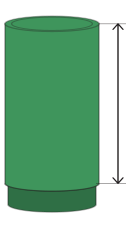
Full-length lidNarrow to medium diameter
MOST COMMONThe lid runs the length of the body, so a closed box reads as a single smooth cylinder. The logo is displayed without a break, and the elevator effect is at its most pronounced in this version.
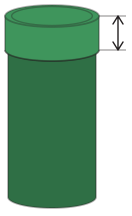
Short lidNarrow to medium diameter
The lid covers only the upper part of the body and the lid line stays visible. The box gives a classic lid-and-body reading.
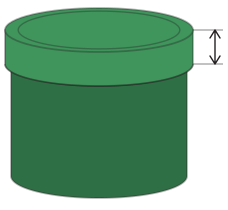
Short lidWide diameter
The same short lid on a wide body gives a squat form with real shelf presence. The wide mouth makes the product easy to reach from above.
Every variant is built from the same two parts: a body, and a lid that wraps it. Any combination of lid height and diameter is possible — these are dimensions of one product, not separate products.
How it is made
The box is two parts — a body, and a lid that wraps around it. A board disc is fitted into the mouth of each tube; the trade counts this build as 2-piece.
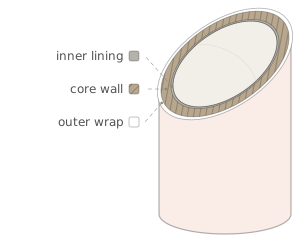
As with every product we make, it starts with the core: the spiral-wound paper tube. The inside surface of the box is created at this stage too — white, black or natural kraft inner paper, and for food products PE-laminated kraft or aluminium lining, are applied while the core is being wound. The lining is not a layer added afterwards.
The sequence in this product runs as follows:
Core material options
Recycled brown board (greyboard)
A core wound from recycled paper. If your brand carries a recycled-content target, this choice feeds it directly.
White Bristol board (white virgin paper)
A core wound from virgin white board. Choose Bristol when the body material itself needs to be white.
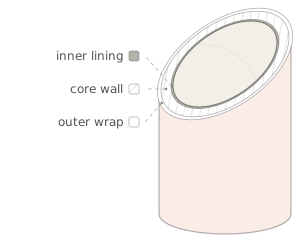
Whichever core material you choose, the lining options are the same — the core material does not restrict the lining. White, black or kraft inner paper, and PE-laminated white, PE-laminated kraft and aluminium for food, can be used with either core.
This holds across our whole tube range.
Production steps
The lid core is wound first.
The body core is wound to a predetermined recipe and then physically tested against the lid core. If it needs modifying it is modified; if not, the run continues.
Body and lid are labelled separately. Which one is labelled first does not matter. Labelling is done on the long core, and cutting comes afterwards.
Rolling is applied to both parts.
Discs are fitted — into the top of the lid and the base of the body.
The lid is fitted over the body and assembly is complete.
Part structure and assembly
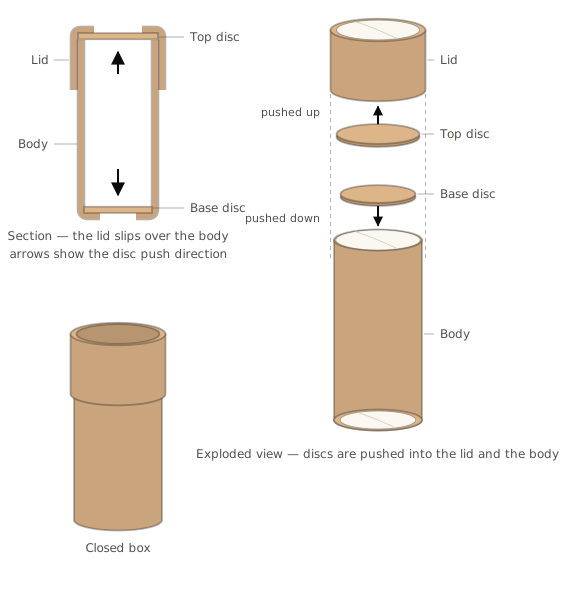 Technical drawing © ArtasPack
The second step is what makes this product what it is: the fit between lid and body is not calculated, it is verified by pushing real parts together. In a telescopic box the only visible proof of quality is the way the lid comes down, and that feel is decided right there.
Four critical stages
The core, the labelling and the rolling are critical in every product. A telescopic tube adds a fourth: setting the friction between lid and body against the weight of what goes inside.
There is a practical reason for it. If a user lifts the box by its lid and the fit is too loose, the body slides down and the product falls. For heavy products we therefore recommend both a tighter lid setting and a security band. If the product going into your box counts as heavy, tell us at the start and we can work out the arrangements that suit it best.
Brandable surfaces
Print is not limited to one face. The first and largest area is the 360-degree outer surface of the lid — on a full-length lid that surface covers almost the whole box. The outer surface of the body is the second field, revealed once the lid comes off; with a short lid it is visible when closed as well and becomes the main part of the design. The top and the base are brandable too — the discs in the lid top and the body base are board, with printed paper mounted on one side.
The option that sets a box apart is the inside face of the lid disc. It is the first surface your customer meets the moment the box opens; a logo, a pattern or a short brand message printed there brands the opening itself. It is not a standard feature, but it is easily done for customers who ask. On wide-diameter boxes one more surface joins it: the inside face of the base disc. As the diameter grows the inside floor becomes a visible ground and lets a pattern resolve inside the box.
On paper: coated, wood-free, kraft, textured fancy and metallised stocks. Printing is offset (Pantone/CMYK) or digital. Finishes: hot foil stamping (gold, silver, copper, rose gold, holographic), embossing and debossing, spot UV and varnish, matt, gloss, soft-touch or anti-scratch lamination. Accessories: cord, ribbon, tassels and a PVC window.
Printing and finishing run through a partner press network rather than a single press, so each project is matched to the right technique — and every printed sheet is inspected when it reaches our plant.


Where it is used
Cosmetics and perfume (luxury fragrance bottles, serums, dermo-cosmetic sets) · chocolate, confectionery, pralines and macarons · single-origin teas and coffees · supplements, vitamins, collagen and protein powders · luxury candles and home fragrance sets · scarves, ties and other textiles presented in a roll · flower boxes, launch kits and nested gift sets. Whisky and premium spirit boxes are one of the largest application areas in the European market.
Because it can be produced at wide diameters, this format works for set presentations as well as for a single product. And because the lid wraps the body, the upper part of the box carries a double layer of board when closed.
How it differs from a butt jointed tube
Both belong to the rolled-edge family. The difference is how the lid holds on to the body.
| Criterion | Telescopic (2-piece) | Butt jointed (3-piece) |
|---|---|---|
| Number of parts | Body + lid | Body + lid + spigot |
| How the lid holds | Wraps around the outside of the body | Seats on the spigot inside the body |
| Diameter relationship | Lid is wider than the body | Lid and body share one diameter |
| Closed appearance | Lid line visible; a full-length lid reads as one piece | Flush; reads as a single cylinder |
| Lid height | Your choice — from short to full length | Set by the spigot height |
This is why the two products are wound on cores of different diameters. If you want a look in which the lid announces itself, or comes all the way down and covers the body entirely, the telescopic build is the one; if you want a flush surface where lid and body share a diameter, the butt jointed build fits better.
Why European brands source this format from Istanbul
Most enquiries that reach us have already been quoted in the Far East, usually China. This is what nearshoring the work to Istanbul changes.
We are the manufacturer, not a trading company
Winding, labelling, die-cutting and assembly all happen in our own plant in Istanbul. You are talking to the people who make the box.
Quotes within 24 hours, approvals inside your working day
Istanbul runs one to two hours ahead of most of Europe, so an approval you send in the morning is answered the same working day rather than overnight.
4–6 weeks faster than the Far East, first enquiry to pallet
Measured against a Chinese or other Far East supplier, and across the whole cycle — quoting, sampling, approvals and shipping — not transit alone. Transit to Central Europe starts at 7 days on full truck loads.
Duty free into the EU and the UK
Goods move duty free into the European Union under the Türkiye–EU Customs Union, and into the United Kingdom under the Türkiye–UK Free Trade Agreement. We quote EXW or DAP delivered to your door, and our export team handles the customs paperwork.
Samples before you commit
Physical samples, printed and unprinted, or 3D digital mock-ups for sign-off before mass production.
Shipping to more than 20 countries
Producing to order since 1986, with a large library of existing tooling — standard sizes carry no additional tooling cost.
What to send us for a quote
Inner diameter and height — or the dimensions of the product going into the box
Tell us if the product going into the box counts as heavy, so we can look at lid-fit options that suit it
Your lid height preference (full length, short, or somewhere in between)
Quantity, and your estimated annual requirement if you have one
Core preference — recycled brown board (greyboard) or white Bristol
Your lining requirement (standard paper, or PE-laminated kraft or aluminium for food)
Print type (CMYK, Pantone) and the finishes you want
The outer paper you want to use, plus any accessories
Your artwork — send it in vector format. The most common cause of delay we see is artwork that is not vector, or is below print resolution. If you do not have a file yet, we will prepare the dieline for you straight away.
Produced in this format


Frequently asked questions
Can we get a sample?
We prepare samples both printed and unprinted — an unprinted sample lets you check the construction and the dimensions, a printed one lets you sign off the finished look. 3D digital mock-ups are available as well.
Do we have to resend the dimensions when we reorder?
No. We archive every quotation, specification and print file for at least two years and pick up from the same file on a repeat order — including the lid fit approved on the first run.
What do we gain by buying here instead of the Far East?
We quote within 24 hours and approvals settle inside your working hours. Measured from first contact to pallet, that works out at a 4–6 week advantage over Far East sourcing; transit to Europe starts at 7 days on full truck loads.
Do you ship duty free to the EU and the UK?
Yes. Goods move duty free into the European Union under the Türkiye–EU Customs Union and into the United Kingdom under the Türkiye–UK Free Trade Agreement. We quote EXW or DAP delivered to your door and our export team handles the customs paperwork end to end.
Is the box recyclable, and can it be produced FSC certified?
The box is paper based. ArtasPack is an FSC®-C184527 certified manufacturer and we can produce under that certificate for customers who ask — you only need to say so at the order stage. Production from recyclable materials is equally an option, planned together with your paper, lining and finishing choices. The boxes are designed to meet the requirements of the EU's PPWR.


