
Butt Jointed Paper Tubes — 3-Piece Shoulder Tube Packaging
A butt jointed paper tube is a three-part cylinder: the body, the lid and the spigot that joins them are each wound and finished separately. It is also known as a shoulder tube, because the spigot forms the shoulder the lid seats on, and as a 3-piece tube. All three names describe this build.

The name comes from the construction itself. The lid does not slide over the outside of the body; it seats on a spigot fitted inside the body. Because the lid and the body share one diameter, a closed box reads from the outside as a single unbroken cylinder — the only thing that gives the lid away is a fine seam line.
The names this format is sold under are set out below. Specifications are written three different ways, and one of the three is easy to misread.
Before you order
| Inner diameter | Choose any diameter between 32 and 140 mm |
|---|---|
| Finished box height | 50–800 mm |
| Minimum order | 1,000 units |
| Construction | 3-piece tube — body, lid and spigot |
| Core material | Recycled brown board (greyboard) or white Bristol board (white virgin paper) — tell us which you prefer |
| Production lead time | From 3 weeks* |
| Door-to-door delivery | From 4 weeks* |
| Tooling | We hold a large number of dies across the 32–140 mm range, so standard sizes carry no additional tooling cost. For bespoke projects we design and cut the tooling in house and bring the project to production quickly. |
| Certification | FSC®-C184527 — FSC certified production is carried out on request |
Every diameter we quote is an inner diameter. Every box is made to order; we do not sell ready-made stock.
* Lead times vary with order quantity and technical specification.
** Applies to full truck loads to Central Europe.
VARIANTS
Lid-to-body ratio
In a butt jointed tube the lid and the body are cut from cores of the same diameter, but their heights are set independently. That ratio changes how the box stands and how it feels to open; it does not change how it is made.
Short lid — long body
MOST COMMONThe lid covers the top of the body as a narrow band. Most of the label area stays on the body, which suits designs that need a wide, uninterrupted field.
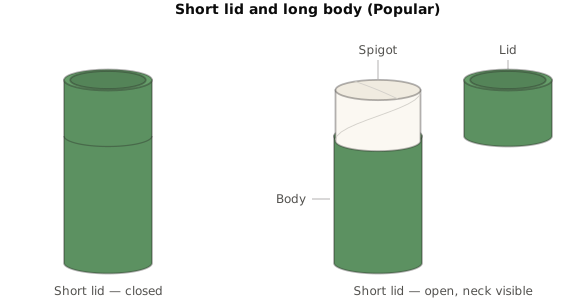 TECHNICAL DRAWING © ARTASPACK
Long lid — short body
The lid covers most of the box, and when it is lifted the spigot shows over a longer run. This proportion is used most often by perfume and cosmetics brands.
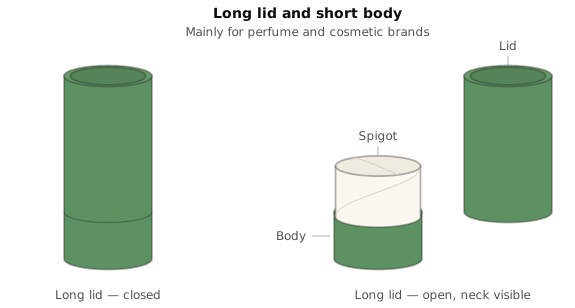 TECHNICAL DRAWING © ARTASPACK
Both variants are built from the same three parts: body, lid and the spigot that joins them. The only thing that changes is the height ratio between lid and body.
How it is made
What separates a good butt jointed tube from an ordinary one lies mostly in the making.
Everything starts with the core — the spiral-wound paper tube that becomes the body. A well-wound core largely determines the quality of the finished box. The inside surface is created at this stage too: white, black or natural kraft inner paper, and for food products PE-laminated kraft, PE-laminated white or aluminium-lined stock, are all applied while the core is being wound. The lining is not a layer added later — it is born with the body.
Core material options
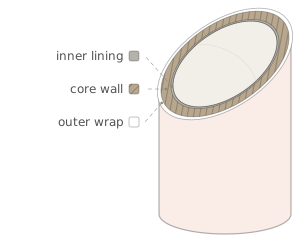
Recycled brown board (greyboard)
A core wound from recycled paper. If your brand carries a recycled-content target, this choice feeds it directly.
White Bristol board (white virgin paper)
A core wound from virgin white board. Choose Bristol when the body material itself needs to be white.
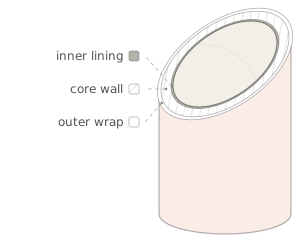
Whichever core material you choose, the lining options are the same — the core material does not restrict the lining. White, black or kraft inner paper, and PE-laminated white, PE-laminated kraft and aluminium for food, can be used with either core.
This holds across our whole tube range.
Production steps
Spigot
The core wound for the spigot goes straight to cutting and is sized to the box. If the spigot is to be labelled as well, it is labelled first and cut afterwards.
Body and lid
Both come from cores of the same diameter. They are labelled first, then sliced to length — the printed sheet is wrapped onto a long core and the cutting follows.
Rolling
The cut body and lid are rolled; the rolled edge is formed at this stage.
Discs
Usually board discs, fitted into the rolled ends.
Assembly
The inside of the body is glued, the spigot is seated into it and the lid is closed onto the box.
Part structure and assembly
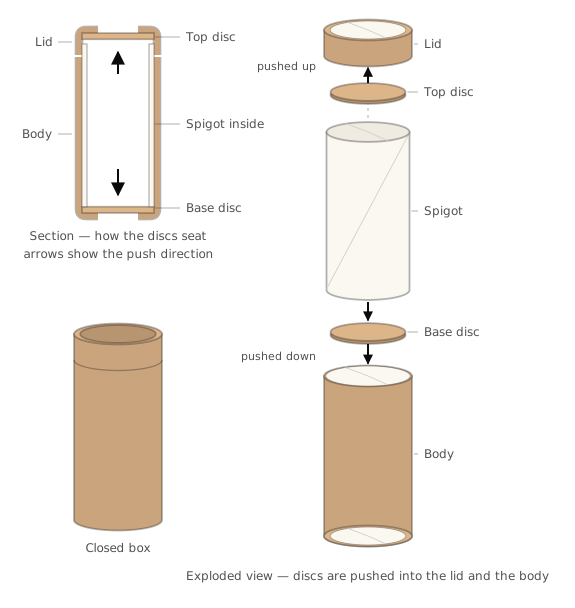 Technical drawing © ArtasPack
Three stages decide the result: the core, the labelling and the rolling. The core is the most demanding of them and governs every stage that follows. Labelling determines how the outer surface reads. Rolling is the second place the eye goes — turning a wound paper wall inwards is difficult and risks deforming the paper. How clean the rolled edge looks tells you directly how well the first two stages were run.
Brandable surfaces
Print is not limited to one face. Beyond the 360-degree outer surface of the body and the lid, the top and the base of the box are brandable too — the discs on those two faces are board, and printed paper is mounted on one side of them.
The option that sets a box apart is the inside face of the lid disc. It is the first surface your customer meets the moment the box opens; a logo, a pattern or a short brand message printed there brands the opening itself. It is not a standard feature, but it is easily done for customers who ask. On wide-diameter boxes one more surface joins it: the inside face of the base disc. As the diameter grows the inside floor becomes a visible ground and lets a pattern resolve inside the box.
On paper: coated, wood-free, fancy and textured stocks. Finishes: foil, spot UV, matt or gloss lamination, varnish, soft touch, anti-scratch lamination, embossing and debossing. Accessories: cord or ribbon, tassels, and a PVC window in the lid or the body.
Printing and finishing run through a partner press network rather than a single press, so each project is matched to the right technique — and every printed sheet is inspected when it reaches our plant.


Where it is used
This format has made a place for itself across sectors: cosmetics and perfume, whisky and craft spirits, chocolate, biscuits and confectionery, coffee and herbal teas, food supplements, candles and home fragrance, detergents and laundry fragrance. Whisky and premium spirit boxes are one of the largest application areas in the European market.
What it offers the end customer is consistent: the lid sharing the body's diameter gives a plain, unbroken exterior, while the spigot creates a soft friction as the lid is drawn off. Together they turn the first opening into something closer to a ritual — the kind of unboxing a customer remembers.
How it differs from a telescopic tube
Both belong to the rolled-edge family and look similar from the outside. The difference is how the lid sits on the body.
| Criterion | Butt jointed (3-piece) | Telescopic (2-piece) |
|---|---|---|
| Number of parts | Body + lid + spigot | Body + lid |
| How the lid holds | Seats on the spigot inside the body | Wraps around the outside of the body |
| Diameter relationship | Lid and body share one diameter | Lid is wider than the body |
| Closed appearance | Flush; reads as a single cylinder | Lid line visible; a full-length lid reads as one piece |
| Lid height | Set by the spigot height | Your choice — from short to full length |
This is why the two products are wound on cores of different diameters. Which one you choose is largely an aesthetic decision: a flush, quiet surface points to the 3-piece build, while a classic look in which the lid announces itself points to the 2-piece.
What this format is called
Three names describe the same build. If your specification uses any of them, this is the product.
| Term | What it means here |
|---|---|
| Butt jointed tube | The name European tube converters use. It refers to the body–spigot–lid construction. In some sources “butt joint” instead describes a seam where two paper edges meet without overlapping — that is not the meaning here. |
| Shoulder tube | The same product, named after the shoulder. The spigot fitted inside the body forms a shoulder and the lid seats on it. Some specifications write “shoulder box”, although in English that term more often describes a rectangular rigid box with a neck. |
| 3-piece tube | Counts the parts: body, lid and spigot. It does not mean a body closed with two end caps — that is a different construction, and its lid does not sit flush with the body. |
Why European brands source this format from Istanbul
Most enquiries that reach us have already been quoted in the Far East, usually China. This is what nearshoring the work to Istanbul changes.
We are the manufacturer, not a trading company
Winding, labelling, die-cutting and assembly all happen in our own plant in Istanbul. You are talking to the people who make the box.
Quotes within 24 hours, approvals inside your working day
Istanbul runs one to two hours ahead of most of Europe, so an approval you send in the morning is answered the same working day rather than overnight.
4–6 weeks faster than the Far East, first enquiry to pallet
Measured against a Chinese or other Far East supplier, and across the whole cycle — quoting, sampling, approvals and shipping — not transit alone. Transit to Central Europe starts at 7 days on full truck loads.
Duty free into the EU and the UK
Goods move duty free into the European Union under the Türkiye–EU Customs Union, and into the United Kingdom under the Türkiye–UK Free Trade Agreement. We quote EXW or DAP delivered to your door, and our export team handles the customs paperwork.
Samples before you commit
Physical samples, printed and unprinted, or 3D digital mock-ups for sign-off before mass production.
Shipping to more than 20 countries
Producing to order since 1986, with a large library of existing tooling — standard sizes carry no additional tooling cost.
What to send us for a quote
Inner diameter and height — or the dimensions of the product going into the box
Quantity, and your estimated annual requirement if you have one
Whether you want a Bristol (white) core. Unless you tell us otherwise we quote on recycled board
Your lining requirement — standard white or kraft paper, or PE-laminated kraft or aluminium for food
Print specification and post-press finishing (CMYK, Pantone, matt lamination and so on)
Any outer paper other than coated stock, plus accessories (cord, rivet, ribbon)
Your artwork — send it in vector format. The most common cause of delay we see is artwork that is not vector, or is below print resolution. If you do not have a file yet, we will prepare the dieline for you straight away.
Produced in this format


Frequently asked questions
Can we get a sample?
Yes. We prepare samples both printed and unprinted — an unprinted sample lets you check the construction and the dimensions, a printed one lets you sign off the finished look. 3D digital mock-ups are available as well.
Is a butt jointed tube the same as a shoulder tube?
Yes — they are two names for one construction. The spigot fitted inside the body forms the shoulder the lid seats on, which is where the second name comes from. A third name, 3-piece tube, counts the parts. Whichever your specification uses, this is the product.
Our artwork is not ready. Can we still start?
Yes. We send you the dieline, and we help place your design onto it.
Do we have to resend the dimensions when we reorder?
No. We archive every quotation, specification and print file for at least two years and pick up from the same file on a repeat order.
What do we gain by buying here instead of the Far East?
We quote within 24 hours and approvals settle inside your working hours. Measured from first contact to pallet, that works out at a 4–6 week advantage over Far East sourcing; transit to Europe starts at 7 days on full truck loads.
Do you ship duty free to the EU and the UK?
Yes. Goods move duty free into the European Union under the Türkiye–EU Customs Union and into the United Kingdom under the Türkiye–UK Free Trade Agreement. We quote EXW or DAP delivered to your door and our export team handles the customs paperwork end to end.
Is the box recyclable?
The box is paper based and can be produced under our FSC®-C184527 certificate on request. With a greyboard core the body is made from recycled paper. The boxes are designed to meet the requirements of the EU's PPWR.


